Institut de recherche mathématique avancée

L'institut
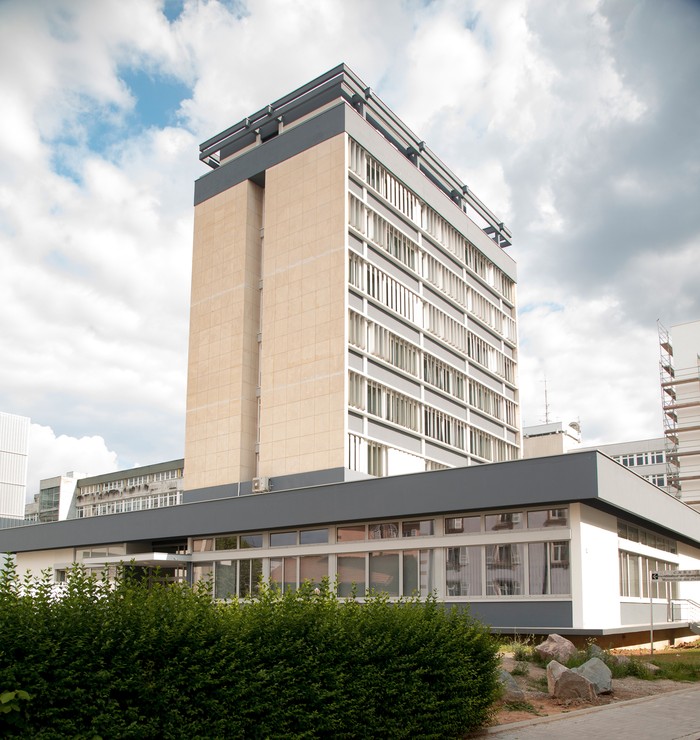
Photo de la tour IRMA

L'IRMA

Riche d’une histoire de plus de 100 ans, l'IRMA est aujourd'hui une unité mixte de recherche sous la double tutelle de l’Institut National des Sciences Mathématiques et de leurs Interactions du CNRS et de l’Université de Strasbourg.

L'Institut est adossé à l'UFR de Mathématiques et Informatique de l'Université de Strasbourg.

Photo de la tour IRMA

L'IRMA

Riche d’une histoire de plus de 100 ans, l'IRMA est aujourd'hui une unité mixte de recherche sous la double tutelle de l’Institut National des Sciences Mathématiques et de leurs Interactions du CNRS et de l’Université de Strasbourg.

L'Institut est adossé à l'UFR de Mathématiques et Informatique de l'Université de Strasbourg.

À la une

Membres du RAURA

Prix Expertises recherche, Idex 2026

Le RAURA (Réseau des administrateurs.trices d'unités de recherche en Alsace) dont fait partie Delphine SCHMITT, administratrice de l'IRMA, est lauréat du Prix Expertises recherche IdEx 2026.


©savoirs.unistra
Membres du RAURA

Prix Expertises recherche, Idex 2026

Le RAURA (Réseau des administrateurs.trices d'unités de recherche en Alsace) dont fait partie Delphine SCHMITT, administratrice de l'IRMA, est lauréat du Prix Expertises recherche IdEx 2026.


©savoirs.unistra

Agenda

  • Vendredi 25 septembre 2026 - 10h00 Thèse

      Colin Fourel : Catégories de flot de Morse comme catégories de chemins sortants
    • Lieu : Salle de conférences IRMA
  • Vendredi 25 septembre 2026 - 16h00 Colloquium Mathématique

      Bruno Klingler : Tame geometry and applications
    • Lieu : Salle de conférences IRMA
    • Résumé : In his Esquisse d’un programme, Grothendieck called for the development of a “tame” topology, free from the pathologies of general topology. Such a framework was developed in the 1980s and 1990s by logicians under the name o-minimal geometry, based on the simple principle that, in dimension one, the only sets considered are finite unions of intervals. Remarkably, this setting has recently led to striking applications in complex algebraic geometry, particularly in Hodge theory, as well as in number theory, notably in Diophantine geometry. This talk will offer an elementary introduction to these ideas.

  • Mardi 29 septembre 2026 - 10h45 Séminaire Calcul stochastique

      Émile Averous : La FK-percolation presque critique en milieu aléatoire
    • Lieu : Salle de séminaires IRMA
    • Résumé : La FK-percolation sur Z^2 est un modèle de mécanique statistique, dont beaucoup de propriétés sont comprises à son point critique, lorsque 1≤q≤4. Dans une boîte de côté N, le modèle conserve son comportement critique précisément lorsque le paramètre p varie autour du point critique, dans une fenêtre de taille W(N). Dans cet exposé, j’expliquerai ce qui se passe lorsque le paramètre critique est perturbé d’une petite valeur aléatoire à chaque arête de Z^2, et je montrerai qu’un phénomène de moyennage permet au modèle de rester critique dans une fenêtre beaucoup plus grande W(N)^{1/3}. Dans le cas de la percolation standard (de Bernoulli), des annulations supplémentaires permettent au modèle de rester critique à toute échelle sous n’importe quelle perturbation aléatoire centrée. Travail réalisé en collaboration avec Rémy Mahfouf

  • Mardi 29 septembre 2026 - 14h00 Séminaire Equations aux dérivées partielles

      Mattia Manucci : Contour Integral Methods for Efficient Time Integration and Model Reduction
    • Lieu : Salle de conférences IRMA
    • Résumé : We discuss a unified framework based on contour integral methods (CIMs) for the efficient numerical treatment of linear evolution problems. The central idea is to apply the Laplace transform to the underlying evolution equation and recover the time-domain solution by numerically approximating the inverse Laplace transform. In contrast to classical time-stepping approaches, this perspective allows the solution to be computed directly at prescribed time instants or over entire time intervals, offering increased flexibility and, in suitable settings, significant computational advantages.
      We first discuss the key features that make a problem particularly well suited to CIMs and then explore how the Laplace-transform framework naturally connects with projection-based model order reduction (MOR). In particular, we show how CIMs can be combined with projection-based techniques to efficiently treat parametric evolution PDEs and control systems. Since the reduction can be constructed from selected solution snapshots rather than from the full set of intermediate states generated by a time-stepping method, the computational cost of the reduction phase can be substantially reduced. For parametric problems, we further discuss a greedy construction of the projection spaces based on suitable error estimates.
      Finally, we extend the CIM framework beyond ordinary differential equations to linear differential-algebraic equations (DAEs), namely, linear dynamical systems subject to algebraic constraints that must be satisfied throughout the evolution. The resulting approach provides an efficient alternative to classical Runge–Kutta methods, which can suffer from order reduction when applied to DAEs.
      Overall, these results illustrate how contour integral methods provide a flexible framework for the numerical solution and model reduction of linear evolution problems, ranging from PDEs and parametric systems to constrained dynamical systems. The seminar will highlight the underlying numerical analysis as well as the computational advantages and limitations of the proposed approaches.

  • Mardi 29 septembre 2026 - 14h00 Séminaire ART

      Ningchuan Zhang : On the rationalization of the $\mathrm{K}(n)$-local determinant sphere
    • Lieu : Salle de séminaires IRMA
    • Résumé : Abstract: In chromatic homotopy theory, we study spectra one prime at a time by the height filtration of formal groups. One way to extract the height $n$ information is to localize at the Morava $\mathrm{K}$-theory $\mathrm{K}(n)$. In their recent breakthrough, Barthel—Schlank—Stapleton—Weinstein computed rational homotopy groups of the $\mathrm{K}(n)$-local sphere using $p$-adic arithmetic geometry. Building on their approach, we study the rational homotopy groups of the $\mathrm{K}(n)$-local determinant sphere and their relationship with Gross–Hopkins duality. This leads us to compute the rational group cohomology of $\mathrm{GL}_n(\mathbb{Z}_p)$ with coefficients in the Steinberg representation. The resulting Poincaré series agrees with the one predicted by the strong Chromatic Splitting Conjecture. This is joint work in progress with Tobias Barthel, Jacob Lerman, Guchuan Li, and Wei Yang.

  • Jeudi 1 octobre 2026 conférence

      Journée de rentrée des doctorants
    • Lieu : Salle de conférences IRMA

Actualités

Toutes les actualités